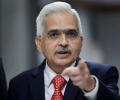
Reserve Bank Governor Shaktikanta Das on Wednesday said underlying economic activity in India continues to be strong, but external factors will cause some "dent" to the economy. Speaking at the BFSI Insight Summit 2022 organised by Business Standard, Das said the RBI tracks 70 fast moving indicators and most of them are in the "green box". It is the external sector, mired by a fear of recession or clear visibility about slowing growth in a large part of the world, where the challenges lie, he said, adding that the impact of external demand will "dent" the economy.

The Reserve Bank on Tuesday allowed banks to open ATMs outside their branches without permission from the central bank.

Starting August, various festivals are celebrated in different parts of the country leading to higher sales of commodities ranging from sweets, fruits and food items

Reserve Bank Governor Raghuram Rajan today criticised multilateral institutions like the IMF and the World Bank saying "they are not immune to cognitive capture".

Analysts are expecting inflation to fall further in October and November on base effect. Inflation measured by consumer prices has been trending down for over four months, and came in at 6.7 per cent in September.

Analysts expect the central bank to remain watchful of inflation.
Unlike in 2008, the pace of revival will be very modest.
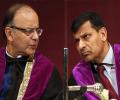
In cutting interest rates and giving a boost to the government's efforts to revive growth, RBI governor Raghuram Rajan displayed the pragmatism and flexibility familiar to those who work with him.

The RBI was not party to the decision to demonetize 500 and 1,000-rupee notes, which was taken at the highest level of India's political leadership.

Rajan addressed a group of investors in Boston on Thursday.

While they have restructured loans, there is still question mark over the success of such a work-out

Firms that should borrow abroad do not do so enough, and those that should not borrow abroad do.

An immediate RBI rate cut will lower lending rates for banks' MSME/retail/mortgage loans before the 'busy' industrial season ends in March.

Today, with growth having slowed and macro-economic challenges in every direction, would the government have benefited from the advice of 'Harvard' economists? asks T N Ninan.

ADB projected China's growth to decelerate from 7.4 per cent

The size of the hole in today's banking crisis appears to be roughly 10 per cent of GDP.

A continued focus on low inflation will be important to keeping gold imports, IMF said.

Drop in oil prices and the government's reform agenda has helped India to be out of the Fragile Five group
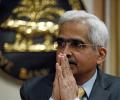
RBI Governor Shaktikanta Das on Tuesday asked private sector banks to ensure continuity in the provision of various financial services, including credit facilities to individuals and businesses, in the face of challenges brought on by the pandemic. Earlier this month, the governor had held a similar meeting with MD and CEOs of public sector banks. During the meeting with the MD and CEOs of select private sector banks, Das also impressed upon the banks to quickly and swiftly implement the measures announced by the RBI on May 5, 2021, in right earnest.

It also recommended that the RBI accounting year (July-June) may be brought in sync with the fiscal year (April to March) from the financial year 2020-21 as it could reduce the need for interim dividend being paid by the central bank.

India's economy is not like Western ones, and thus needs restrained fiscal policy even during a recession, says Ajay Shah.

The principal challenge for Rajan's successor is to work with the Bank Board Bureau and the finance ministry to complete these processes of banking reform.

'The Reserve Bank's independence has remained a work in progress, an enduring challenge that the nation has been grappling with on an ongoing basis,' says RBI Deputy Governor Dr Viral Acharya.

According to D&B, food price levels might witness a rebound as foodgrain production is estimated to have declined during 2014-15.

To cut interest rates, the central bank head has to open up a debate on inflation target revision.
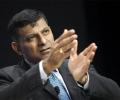
Rajan, as expected, furthered his predecessors' agenda and continued with the same resolution to make India's financial system safer, and direct the economy towards further liberalisation
Reserve Bank Governor Shaktikanta Das on Friday said the rupee is holding up relatively well when compared to the currencies of emerging market peers and advanced economies. Days after the domestic currency breached the 80-level against the dollar, Das said Reserve Bank of India (RBI) has zero tolerance for volatile and bumpy movement in the rupee and added that the central bank actions have helped in smoother movement. He said RBI has been supplying US dollars to the market to ensure adequate supply of liquidity and also clarified that the central bank does not target a particular level for the currency.

Finance minister Arun Jaitley has delivered a Arun Jaitley delivered a bold, far sighted budget

Three years after India declared its goal to become a net-zero economy by 2070, the policy design for achieving the target has begun, with the NITI Aayog forming dedicated multi-sectoral committees to prepare a transition plan. In 2021, India joined a select group of nations that set a target year for becoming net-zero carbon economy. At COP26 in Glasgow, Prime Minister Narendra Modi outlined a five-pronged 'Panchamitra' climate action target for India and committed to a net-zero target by 2070, joining nations like the US, the UK, and China.

The Reserve Bank on Friday retained the GDP forecast for the current financial year at 9.5 per cent and flagged global semiconductor shortages, elevated commodity prices and potential global financial market volatility as downside risks to economic growth. In his address after the three-day meeting of the rate-setting panel, RBI Governor Shaktikanta Das said recovery in aggregate demand gathered pace in August-September, and it is reflected in high-frequency indicators, like railway freight traffic; port cargo; cement production; electricity demand; e-way bills; GST and toll collections. "The ebbing of infections, together with improving consumer confidence, has been supporting private consumption," he said, and added the pent-up demand and the festival season should give further fillip to urban demand in the second half of the financial year.

'We are very watchful about inflation and growth. But the main challenge is economic revival and growth.'

The year 2014-15 could well go as one of long-pending financial sector reforms, expected to have a lasting impact.

For all its claims to economic glory, the majority of India's population lives vulnerable lives, a situation that has only worsened over the past 15 years, to the extent that the government now fears to release economic data or even conduct a proper Census, notes Rathin Roy.

The change from wholesale to retail inflation as an anchor means that the weightage of diesel in inflation has decreased
By no means do economists see the Reserve Bank of India stop at just a 25-bp cut. Some of the economists such as Soumyakanti Ghosh of State Bank of India are of the firm view that rates have room to fall by a total of 75 bps in the current financial year, starting with 25 bps in the August 7 policy.

Analysts at Bank of America Merill Lynch said that fears of inflation getting "generalised" are overdone, as only two sub-categories of fuel and light and housing (accounting for 22 per cent of the basket) have seen a price-rise above the headline 5.2 per cent.
'A strong foreign exchange reserve is the best safety net against global spillovers.'

The central bank will come out with two measures on restructuring to tackle financial stress, Rajan said.

'If you look at the order books of capital equipment companies or money deployed on the ground, there is forward movement in terms of actual investment by the private sector.'
